
The seven rules
If you read nothing else on this page, read this. Bougainvillea is not a demanding plant, it is a misunderstood one. Almost every failure comes from treating it kindly in the ways it does not want.
- Six hours of direct sun, minimum. Shade guarantees no flowers. There is no workaround.
- Underwater it. Water only when the leaves just begin to droop. Overwatering is the number one killer.
- Keep the pot small. It flowers hardest when slightly root bound. A big pot gives you a big green bush.
- Never feed nitrogen. No urea, no lawn fertiliser. Nitrogen produces leaves at the direct cost of bracts.
- Drainage must be instant. Water should disappear through the pot in about fifteen seconds.
- Prune after every flush. Flowers form only on new growth, so every cut you make multiplies the next bloom.
- Do not disturb the roots. The root system is brittle and unforgiving. Repot rarely and gently.
Know the plant
Bougainvillea belongs to the Nyctaginaceae, the four o’clock family. Nearly everything grown in India is a complex hybrid of three South American species, and knowing which one your plant leans towards tells you how it will behave.
- B. spectabilis has velvety hairy leaves and stems, heavy curved thorns, and jewel toned purple and magenta bracts. It gives one enormous seasonal flush from late winter into summer.
- B. glabra has smooth glossy leaves, slender straight thorns and smaller bracts. It flowers repeatedly through the year on each new flush.
- B. peruviana has greenish bark and crinkled rose pink bracts, and flowers in response to dry spells.
- B. × buttiana, the glabra and peruviana hybrids, gives us crimson, orange, terracotta and salmon, usually fading to pink with age.
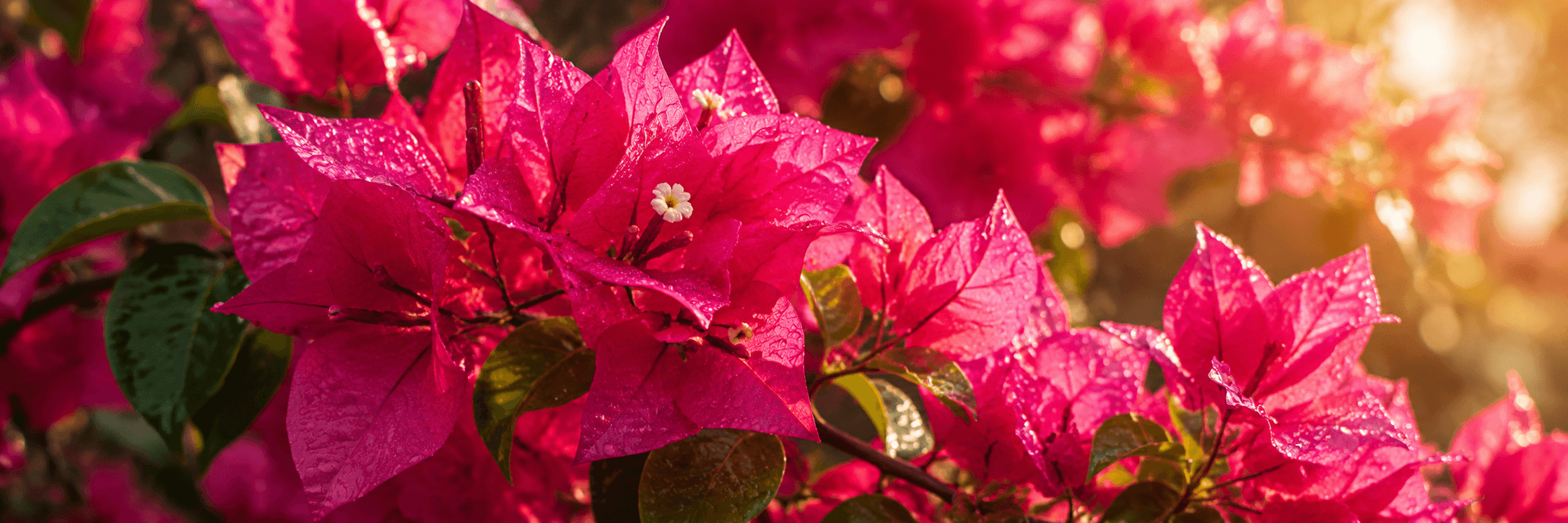
The flowers are not flowers. The colour comes from three modified leaves called bracts. The true flower is the small creamy white tube at the centre of each trio. Bract colour comes from betalain pigments rather than the anthocyanins most flowers use, which is why the colour is so intense in hard light and why dried bracts hold their colour for months.
Two structural facts shape everything else. First, it is a scrambler, not a true climber: it has no tendrils and no adhesive pads, so it must be physically tied to any support. Second, the roots are brittle, sparse and papery, and they do not form a self binding ball. They snap under finger pressure and recover from damage badly. That single fact drives most of the potting advice below.
In a container it will hold anywhere from 0.5 m to 2.5 m depending entirely on how you prune it, and it can live and improve for twenty to fifty years. Growth is fast: an unpruned plant can put out one to two metres of vining growth in a single monsoon.
Growing across India
Bougainvillea grows across the whole country, from Srinagar gardens to Kanyakumari terraces, but the calendar and the risks shift with the region. The plant wants the same four things everywhere: sun, sharp drainage, restricted roots and low nitrogen. What changes is when it blooms and what is most likely to kill it.
North India
Delhi, Punjab, Haryana, Uttar Pradesh, Rajasthan and the plains up to the Himalayan foothills.
- Peak bloom: late February to April, and again in October and November. The long dry spring is ideal.
- Main risk: winter cold. Below about 5 °C the plant defoliates, and frost in Punjab and Rajasthan can kill young plants outright. Move pots against a south facing wall from December to mid February, cut watering right back, and do not panic at bare branches.
- Summer: the plant loves 45 °C. Loo winds dry pots fast, so terracotta may need daily morning water in May and June even though the plant wants to stay dry.
- Soil note: north Indian groundwater and soils tend to be alkaline, which locks up iron. Yellow new leaves with green veins are common here. Keep chelated iron on hand and lean acidic in your mix.
- Hard prune: mid to late February, once frost risk has passed.
South India
Tamil Nadu, Karnataka, Kerala, Telangana, Andhra Pradesh and Goa.
- Peak bloom: effectively year round, with the heaviest flushes from December to March. There is no cold dormancy to work around.
- Main risk: too much rain and too little rest. Coastal Kerala and the Konkan get so much moisture that plants grow lush and never flower. Drainage and drought stress matter more here than anywhere else.
- Two monsoons: the east coast gets the retreating monsoon in October and November, so Chennai and coastal Andhra growers should plan the autumn flush around it rather than through it.
- Advantage: the Deccan plateau, around Bengaluru, Hyderabad and Pune, may be the finest bougainvillea climate in the country. Dry air, strong light, mild nights and free draining red soil.
- Hard prune: flexible. Prune after each major flush rather than on a fixed date.
East India
West Bengal, Odisha, Jharkhand, Bihar, Assam and the northeast.
- Peak bloom: December to February, with a second flush in April and May.
- Main risk: the monsoon. Four months of heavy, persistent rain from June to September will rot roots in any pot that does not drain instantly, and will push the plant into pure leaf growth. Pot feet are not optional here.
- Humidity: high humidity through the year invites fungal leaf spot. Space pots for airflow and never water overhead in the wet months.
- Advantage: mild winters produce spectacular winter displays with no cold protection at all.
- Hard prune: late February.
West India
Maharashtra, Gujarat, Madhya Pradesh and the western coastal belt.
- Peak bloom: November to March, with an excellent second flush after the monsoon withdraws.
- Main risk: intense but short monsoon rainfall, especially along the Konkan coast and in Mumbai, where a single week can waterlog a pot. Inland Gujarat and Madhya Pradesh have the opposite problem, with saline groundwater causing crisp brown leaf edges.
- Advantage: the arid belt of Gujarat and Rajasthan borderland is close to the plant’s native conditions, and blooms there are outstanding with almost no intervention.
- Salt: where groundwater is hard, flush pots with harvested rainwater every few months to clear mineral buildup.
- Hard prune: February.
Coastal and high altitude
- Coastal, any region: salt tolerance is exceptionally high, so bougainvillea is one of the best flowering choices for seafront balconies where most plants scorch.
- Hill stations above roughly 1,500 m: it survives but rarely performs. Cool nights and lower light suppress bract formation. Grow it in the sunniest position you have and accept a shorter season.
Sun, heat and climate
This is a solar powered plant that evolved on dry, rocky, sun baked hillsides. Most of India suits it almost perfectly.
- Sunlight: six hours of direct, unobstructed sun is the absolute floor. More sun produces deeper bract colour, because the pigment is partly a sunscreen the plant manufactures for itself.
- Ideal temperature: 15 °C to 35 °C, tolerating 5 °C to 45 °C without complaint. It bakes happily on concrete at 45 °C.
- Cold: a night below 10 °C can cause sudden leaf drop. This is normal and it flushes back stronger. Frost, which is a real risk in the north, is a different matter and needs protection.
- Monsoon: it survives easily but stops flowering, because heavy rain triggers aggressive green growth. Drainage is the whole game during the rains.
- Humidity: tolerates high humidity, but prefers dry air for maximum bloom.
- Wind, salt and pollution: outstanding on all three. It is used as a highway divider across Indian cities for exactly this reason.
Terrace note: a mature plant in a 16 inch terracotta tub weighs 35 to 45 kg. Place heavy tubs over structural beams or columns, not mid span, and keep thorny branches from scraping against parapet waterproofing.
Pots and drainage
Restricted roots are not a compromise here, they are the technique. A plant in a pot slightly too small will out flower the same plant in a generous one every single time.
| Stage | Diameter | Depth | Soil volume |
|---|---|---|---|
| Young sapling, first year | 6 inch | 6 inch | 3 L |
| Compact shrub | 8 inch | 8 inch | 5 L |
| Large shrub or tree form standard | 12 inch | 12 inch | 20 L |
| Maximum practical display tub | 16 inch | 14 inch | 30 L |
- Material: unpainted terracotta or heavy cement fibre. Terracotta breathes and dries fast, which induces flowering. Avoid lightweight plastic, because the canopy catches wind and light pots blow over on terraces.
- Drainage holes: at least four holes of 1.5 to 2.0 cm on a 16 inch tub. Cover with mesh, then a 2 cm layer of coarse brick chips.
- Pot feet: non negotiable. Raise the pot 5 cm so it drains completely and so roots cannot escape into the slab.
- Never stand the pot in a decorative saucer that holds water.
Soil recipes
Standard garden soil and rich potting compost will both kill a bougainvillea slowly. It wants a lean, gritty, fast draining mineral mix that mimics a stony hillside. Target a slightly acidic pH of 5.5 to 6.5, organic matter kept down to 10 to 15% by volume, and a drainage rate where poured water vanishes in about fifteen seconds.
Recipe A, starter mix for rooted cuttings and young plants
- 40% coarse river sand
- 30% garden loam
- 20% perlite or brick chips
- 10% sieved compost
Low fertility and high drainage push out roots fast without rotting the delicate new growth.
Recipe B, final tub mix for mature blooming plants
- 35% coarse river sand
- 30% garden loam
- 25% brick chips or pumice
- 10% mature compost
- Plus 20 g bone meal and 10 g neem cake per 10 L of mix
This drains instantly through the monsoon and lets you induce drought stress on demand.
The old growers’ trick: traditional Indian gardeners mix crushed over burnt brick grit, sold locally as surki or jhama, into river sand. Unlike ordinary soft brick it is hard and porous and never breaks down into mud. It is the closest cheap substitute for the stony native soil, and it is why the old terrace plants bloom the way they do.
Ground planting: dig a hole twice as wide as the root ball and backfill with half excavated soil, half coarse sand and grit, to break up heavy clay.
Potting and repotting
Root disturbance tolerance is very low. Treat every repotting as surgery.
- From a nursery polybag: slit the plastic down the side and slide the plant in whole. Never tease, shake or break the root ball.
- Interval: every three to four years, and only when water stops draining or the plant visibly loses vigour. Roots reaching the pot wall is not a reason to repot, it is a reason to expect flowers.
- Progression: 6 inch in year one, 8 inch in year two, 12 inch by year three, a 16 inch final tub from year four.
- Best months: February to March, before the spring flush. Never during peak flowering or peak monsoon.
- Top dressing: every February, scrape off the top 5 cm of soil and replace with fresh mix containing bone meal. This replaces most repotting.
- Root pruning: only for bonsai work, no more than 15% of the outer root mat, in late winter, handled with great care.
Watering and the drought stress technique
Overwatering is the leading cause of death and the leading cause of a green, flowerless plant. When you do water, water deeply until it runs from the drainage holes, then leave it alone until the soil is properly dry.
- Summer, March to May: deep watering when the leaves just begin to droop, perhaps every one to two days in a sandy mix in full sun.
- Monsoon: withhold entirely unless there is a long dry spell. Rely on rain and manage drainage.
- Winter, November to February: very sparingly, roughly weekly. The soil should dry almost completely between waterings.
- Time of day: morning, always.
- Water: harvested rainwater is excellent and avoids the salt buildup that hard groundwater causes.
The drought stress bloom technique
This is the single most reliable trick in bougainvillea growing. If a healthy plant is producing only leaves, stop watering completely until the leaves wilt visibly, then water deeply. Repeat this wilt and water cycle two or three times. The plant reads the stress as a threat to its survival and responds by flowering hard to reproduce. Pair the final watering with a dose of 0:52:34 and you will get an explosive flush.
One caution: never drought stress a plant that is already in bloom. Sudden drying while bracts are open makes them drop within days.
Reading the plant
- Overwatered: lush dark green vining growth and no flowers at all, later yellowing and leaf drop.
- Underwatered: severe wilting, crisping leaf edges, and dropped bracts if pushed too far.
- Emergency recovery from severe drought: submerge the whole pot in water for thirty minutes, then drain fully.
Feeding
The rule is simple: low nitrogen, high phosphorus and potassium. Nitrogen definitively suppresses bract formation in favour of leaves.
Organic schedule, preferred
- February and September: 50 g vermicompost, 20 g bone meal and 10 g neem cake per 12 inch pot.
- Growing season: dilute mustard cake liquid feed at most once every two months, and sparingly.
- Late November: a heavy dose of 30 g bone meal plus 20 g wood ash for potassium, to fuel the winter flush.
Chemical schedule, alternative
- March to October: NPK 13:0:45 or 0:52:34 at 1 g/L every twenty days.
- Bloom trigger: drought stress followed by 0:52:34 is the most reliable combination there is.
- December: a single application of 0:52:34.
Micronutrients
- Magnesium: deficiency is very common. Spray Epsom salt at 2 g/L monthly.
- Iron: chelated iron, Fe-EDTA, at 0.5 g/L when new leaves yellow with green veins. Essential in alkaline northern soils.
- Calcium: 10 g agricultural gypsum annually.
- General: micronutrient mix at 0.5 g/L every two months if foliage looks pale. Spray in early morning.
What never to feed: plain urea or high nitrogen lawn fertiliser. The plant becomes a green monster and will not produce a single flower.
Why it will not bloom
Bougainvillea is a facultative short day plant, which is why it blooms so heavily through the Indian winter and spring when days and nights are close to equal. Flowers form only at the tips of new growth, in flushes: a heavy bloom lasts four to six weeks, then the plant rests and grows vegetatively before the next flush.
The five levers, in order of impact:
- Light. Full, unobstructed sun.
- Water stress. Withhold until wilting.
- Root restriction. Keep the pot small.
- Low nitrogen, high potassium. Bone meal or 0:52:34.
- Pruning. After every flush, to generate new shoot tips.
If a plant is not flowering, the cause is one of four things: too much water, too much nitrogen, too much shade, or a pot that is too large. It is essentially never anything else.
Pruning and training
Because flowers form on new growth, pruning is not maintenance, it is the flowering mechanism. Every cut forks one branch into two or three, which multiplies your flowering points for the next flush.
- Routine tip pruning: once a branch finishes flowering, cut it back by about a third, taking the spent bract cluster with it.
- Hard pruning: late February or early March, before the spring growth, and after frost risk has passed in the north. Cut back major branches and remove long unruly water shoots to set the shape for the year.
- Water shoots: the long, green, thorny stems that rocket straight up rarely flower. Remove them at the base and the energy redirects into flowering wood.
- Renewal pruning: take out dead and crossing branches at the base.
- Pinching: pinch soft new tips regularly to build a dense canopy, which is what turns a bloom into a solid ball of colour.
Training
- Trellis and pergola: it has no tendrils, so tie the branches physically with heavy jute or plastic ties.
- Standard, the lollipop tree: tie a single strong shoot to an iron stake and pinch the top canopy constantly.
- Bonsai: one of the finest tropical bonsai subjects. The trunk ages into rugged, gnarled character and root restriction produces miniature floral explosions. ‘Singapore Pink’ and ‘Sanderiana’ are the classic choices.
Safety: wear heavy leather gloves and long sleeves. Bougainvillea thorns are brittle and carry a mildly irritating sap, and a scratch will ache and throb for far longer than an ordinary one. Use clean, sharp bypass secateurs.
Propagation
Seed is almost never used, since fruit rarely sets in cultivation.
Cuttings, the standard method
- Take 15 to 20 cm hardwood or semi hardwood cuttings from pencil thick branches, during the monsoon months.
- Treat the cut end with IBA rooting hormone at 0.3%, or fresh aloe vera gel as an organic substitute.
- Push deeply into moist coarse sand or vermiculite.
- Keep in partial shade and high humidity. Roots form in four to six weeks, with about an 80% success rate on monsoon cuttings.
Air layering, gooty
Very successful during the monsoon on pencil thick stems. Peel a 1 inch ring of bark, pack it with damp sphagnum moss and soil, wrap in plastic and tie both ends. Roots appear in about forty five days; cut below them once they turn brown.
Grafting
This is how the multi colour rainbow bushes sold across India are made. Scions of different colours are cleft grafted onto one hardy rootstock in late winter or early monsoon. Expect first flowers six to twelve months from a rooted cutting.
The year in twelve months
This calendar suits most of the plains. Shift it two to three weeks later in the far north where winter runs long, and treat it loosely in the south where flowering is continuous.
| Month | Phase | Feeding | Pruning | Watch for |
|---|---|---|---|---|
| January | Peak bloom | 0:52:34 once | None | Cold damage in the north |
| February | Bloom slows | Top dress bone meal | Hard prune | Aphids on new growth |
| March | Spring flush | NPK 13:0:45 | Tip prune | Looper caterpillars |
| April | Peak bloom | Epsom salt spray | None | Spider mites |
| May | Peak bloom | 0:52:34 once | None | Spider mites, pots drying out |
| June | Vegetative | None | Tip prune long shoots | First rains waterlogging pots |
| July | Monsoon growth | None | Tie and train | Root rot |
| August | Monsoon growth | None | Tie and train | Leaf spot |
| September | Post monsoon | Top dress bone meal | Tip prune heavily | Fungal disease in humid regions |
| October | Bud initiation | NPK 13:0:45 | Stop pruning | Retreating monsoon in the southeast |
| November | Pre winter flush | Wood ash and bone meal | None | Nothing much |
| December | Peak bloom | 0:52:34 once | None | Cold night leaf drop |
Repotting and propagation slot in around this: repot in February or March, take cuttings and graft through the monsoon, pot up rooted cuttings in September.
Cultivar guide
Twenty varieties that perform well in Indian containers, grouped by what they are for.
Multi bract and double forms
- ‘Mahara’, also sold as Cherry Blossom. Fully double carmine pink bracts like clusters of miniature roses, dense mounding habit, very few thorns.
- ‘Poulton’s Special’. Rumpled magenta crimson doubles, very short internodes, naturally bushy and easy to manage.
- ‘Alba Double’. Crisp white doubles that dry to cream rather than shedding. Slender arching branches need support.
- ‘Pagoda Pink’. Tiered multi bract clusters. Stiff upright branches with strong thorns, needs regular tip pruning.
Variegated foliage
- ‘Thimma’. Creamy gold leaf centres rimmed in deep green, with irregular white and magenta bracts. Looks good even out of bloom.
- ‘Vickie’. Pale yellow leaf centres, bright pink bracts. Slower and less aggressive, and much sought after for containers.
- ‘Raspberry Ice’. Deep raspberry bracts over white margined leaves, compact and dwarf. Excellent in small pots.
- ‘Bambino Baby Allison’. Ultra dwarf, rounded, effectively thornless, dense masses of pale pink.
Chimeras and multi colour
- ‘Mary Palmer’. A natural chimera producing pure white and vivid magenta bracts on the same branch. Vigorous, heavily thorned, needs a large pot and firm pruning. A classic across old Indian gardens.
- ‘Imperial Delight’. Opens white and darkens to soft pink from the edges inward, so the canopy is permanently two toned.
- ‘Thai Delight’. White bracts brushed with magenta pink tips, flowers almost continuously in full sun.
Solid colours
- ‘Barbara Karst’. Bright crimson red, blooms young, forgiving of watering mistakes. The most dependable red for beginners.
- ‘Singapore Pink’. Soft lavender pink, small leaves, largely thornless. One of the best bonsai subjects.
- ‘California Gold’. Warm gold ageing to bronze apricot. Needs strict watering control or it drops buds in wet weather.
- ‘Shubhra’. Snowy white cascades, an Indian selection bred for hot plains summers. Vigorous.
- ‘Scarlet Queen’. Velvety scarlet orange, stiff upright branches, heavy thorns.
- ‘Partha’. Deeply crinkled terracotta bronze ageing to magenta. Tough in wind and coastal conditions.
- ‘Golden Glow’. Flat clusters of deep yellow orange, spreading habit, trains well as a standard.
- ‘Sanderiana’. Classic dense purple, tiny leaves, short internodes, takes hard pruning and flowers in small pots.
- ‘Torch Glow’. Unique columnar habit with blooms clustered up vertical stems, mostly thornless. Ideal for narrow balconies.
Pests
Bougainvillea looper caterpillar
Slender green or brown inchworms that camouflage perfectly along the stems and feed at night. Leaves show clean scalloped edges, and a bad infestation strips the tender tips and stops flowering.
- Organic: inspect at night with a torch and hand pick. Spray Bacillus thuringiensis at 1 g/L in the evening.
- Chemical: Emamectin Benzoate 5% SG at 0.3 g/L, with a fourteen day interval before handling branches closely.
Aphids
Clusters of soft green or black insects on the tenderest tips. New leaves curl and twist, and the sticky honeydew they leave draws ants and black sooty mould.
- Organic: knock them off with a jet of water, then spray neem oil at 3 mL/L with a few drops of liquid soap.
- Chemical: Thiamethoxam 25% WG at 0.25 g/L.
Red spider mites
A hot, dry, dusty terrace problem, worst in April and May and severe across the dry north and west. Leaves go dull with fine yellow speckling, and fine silk webbing appears around the growing tips.
- Organic: wash the undersides of leaves with cold water during morning watering to break the breeding cycle.
- Chemical: Propargite 57% EC at 1 mL/L, or Spiromesifen 22.9% SC at 0.5 mL/L.
Diseases
Root rot
Caused by soil borne water moulds, Phytophthora and Pythium, in warm, soggy, badly drained pots. The signature symptom is a plant wilting badly while the soil is wet. Leaves yellow and drop, stem bases soften, and if you slide the plant out the fine roots are black and mushy with bark slipping off under pressure.
- Prevention: Recipe B mix, pot feet, no saucers, complete drying between waterings. Prevention is essentially the entire treatment.
- Chemical: if caught very early, let the soil dry and drench with Metalaxyl 8% + Mancozeb 64% WP at 2 g/L. Once rot reaches the trunk base the plant cannot be saved.
Alternaria leaf spot
Small circular reddish brown spots with dark borders on mature leaves during warm humid monsoon months, spreading until surrounding tissue yellows and drops. Most common in the humid east and along both coasts.
- Prevention: space pots for airflow and never water overhead in humid weather.
- Chemical: Copper Oxychloride 50% WP at 2 g/L or Carbendazim 50% WP at 1 g/L.
Nutrient deficiencies
| Nutrient | What you see | Fix |
|---|---|---|
| Nitrogen | Stunted growth, uniformly pale green leaves | Dilute mustard cake liquid feed. Use sparingly. |
| Phosphorus | Reddish purple tint on older leaves, poor blooming | Bone meal, or 0:52:34 |
| Potassium | Browning at leaf tips and margins | Wood ash, or K₂SO₄ at 1 g/L |
| Calcium | Distorted new leaves | Gypsum, or calcium nitrate at 1 g/L |
| Magnesium (very common) | Yellowing between green veins on older leaves | Dolomite, or Epsom salt at 2 g/L monthly |
| Iron (common) | Yellowing of the youngest leaves, veins staying green | Humic acid, or Fe-EDTA at 0.5 g/L |
The older versus newer leaf distinction is the whole diagnosis. Magnesium moves within the plant and is stripped from old leaves first, while iron does not move and so fails at the new growth. Iron chlorosis is far more common in the alkaline soils of the north and west than in the acidic soils of the east and the Western Ghats.
Troubleshooting
Lots of leaves, no flowers
Excess nitrogen, overwatering, or shade, usually all three. Internodes longer than 5 cm confirm it. Move to full sun, stop watering until it wilts, stop all nitrogen, and feed 0:52:34.
Bracts brown and drop within days of opening
Shock from drying out too fast, a cold draught, or being moved. Check whether the soil ball has shrunk away from the pot wall. Keep watering steady and light while flowers are open, and do not move pots mid bloom.
Yellow leaves with bright green veins
Magnesium if it is the older lower leaves, iron if it is the new tips. Spray Epsom salt at 2 g/L, Fe-EDTA at 0.5 g/L, or both in early morning.
Long green thorny stems shooting straight up
Water shoots. Cut them off at the base, since they rarely flower and they drain the plant.
Dry, crisp, curling brown leaf edges
Salt buildup from over fertilising or hard groundwater, a common problem across the drier north and west. Look for a crusty white ring inside the pot rim, then flush the pot with plain rainwater for a full five minutes.
Sudden total leaf drop in winter
A natural response to a cold night below 10 °C. Do nothing except reduce watering. It will flush back, usually with heavy flowers.
Wilting during the day although the soil is damp
Root rot has destroyed the fine roots. Slide the plant out and check, since black mushy roots confirm it. Drench with Metalaxyl and Mancozeb at 2 g/L and hold off water.
Long thin stems, tiny leaves, no flowers
Starving for light, almost certainly under three hours a day. Move it to open sky.
Frost damaged branches in the north
Wait until late February before cutting anything. Wood that looks dead often is not, and pruning too early exposes fresh tissue to another cold night. Scratch the bark with a thumbnail, and if it is green underneath, leave it.
Buying a healthy plant
- Look for thick woody basal stems, bright bract colour and healthy green leaves. Dwarf varieties should be compact and bushy.
- Check for pests: aphids on the tender tips, irregular chewed holes from loopers.
- Buy in bloom, October to March, so you can verify the colour yourself. Mislabelled stock is common, and standard magenta is routinely sold as rare white or gold.
- The basket scam: cut flowering branches are sometimes dipped in hormone and packed into clay days before sale, with no root system at all. Tug gently at the base, because a real plant is firmly anchored.
- Never buy a torn polybag. The roots are brittle and a crumbling root ball means severe transplant shock.
- Root bound is fine. Roots escaping the bag are not a defect here, they are a promise of flowers.
Cut and dried flowers
Cut branches in the cool early morning, choosing stems where the central true flowers have just opened so the bracts are fully developed and firm. Use a clean sharp blade and put the stems straight into deep water. They hold in a vase for seven to fourteen days.
For drying, hang whole branches upside down in a dark, dry, low humidity room for about two weeks. Because the colour comes from stable betalains rather than fragile anthocyanins, dried bracts keep their brightness for months and make excellent arrangements.
Questions we get asked
How do I get it to flower?
Full sun, stop watering until the leaves wilt slightly, then feed high phosphorus and potassium such as bone meal or 0:52:34. Never urea, never high nitrogen.
Is it safe around children and pets?
The plant is non toxic, but the thorns are a genuine physical hazard. Keep large plants out of play areas, and prefer thornless types like ‘Torch Glow’ or the ‘Mahara’ series in tight spaces.
Can I grow it in a small pot?
Yes, and it prefers it. An 8 inch pot will hold a plant for years with regular hard pruning.
Will it survive a Delhi winter?
Yes, though it will drop its leaves. Move pots to a sheltered south facing spot, cut watering right back from December, and do not prune until late February. Frost kills young plants, so first year saplings deserve real protection.
Why are there different colours on one plant?
Either it is grafted, with several varieties on one rootstock, or it is a natural chimera such as ‘Mary Palmer’.
Do the thorns disappear with age?
No. Buy a thornless or semi thornless variety if that matters to you.
It is losing leaves. Is it dying?
In winter or after a dry spell, no, that is normal and it will regrow. Losing leaves while sitting in soggy soil is root rot and is serious.
How often should I repot?
Every three to four years, and only when genuinely necessary. The roots are fragile and hate disturbance.
A note on the plant
Bougainvillea reached India by way of a French naval voyage. It was collected in Rio de Janeiro in 1768 by the botanist Philibert Commerson, who named it for his friend Admiral Louis Antoine de Bougainville. It has been here long enough to become native to the imagination: over gates and boundary walls, along highway dividers, across temple courtyards and terrace parapets in every city in the country.
It is also, in the language of flowers, the symbol of passion and liveliness. Given how it responds to hardship by blooming, that seems about right.
Every plant we ship comes with free access to our growing specialists. If your bougainvillea is struggling, message us on WhatsApp with a photo of the whole plant and a close up of the affected leaves, and we will diagnose it with you.