Bougainvillea Pests and Diseases: What's Wrong and How to Fix It
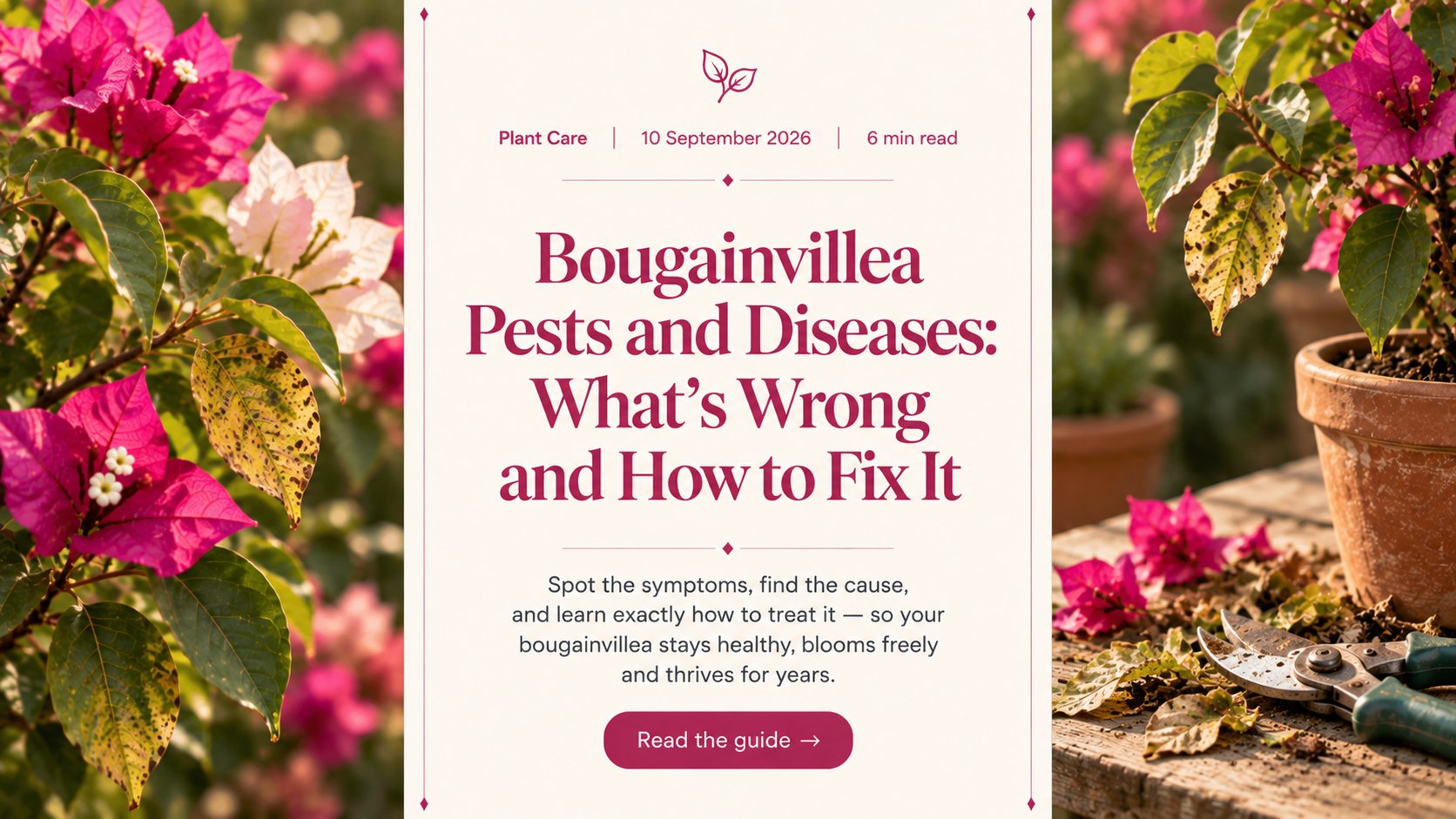
Bougainvillea is remarkably pest-resistant compared to most flowering shrubs, which is exactly why the occasional problem catches growers off guard. This is not an exhaustive pest encyclopedia — it is the short list of things that actually show up on Bengal balconies and terraces, sorted by symptom, so you can go straight to the fix.
Chewed or skeletonised leaves: looper caterpillars
Ragged holes along the leaf margin, or in bad cases whole leaves reduced to a lace of veins, almost always means looper caterpillars — small green inchworms most active during the monsoon growth flush.
- Hand-pick what you can see; a light infestation is genuinely easiest to solve this way.
- For anything more, spray neem oil (5 ml per litre with a drop of liquid soap as an emulsifier) in the evening, repeated weekly until they are gone.
- A heavy, established infestation can be knocked back with a labelled contact insecticide as a last resort — but on a plant grown for flowers, not fruit, neem is almost always enough.
White cottony clumps in the leaf axils: mealybugs
Small white, waxy insects clustering where leaves meet the stem, sometimes followed by a black sooty coating on the leaves below (a mould growing on the honeydew they excrete, not a disease in its own right).
- Light infestation: wipe the clusters off with a cotton swab dipped in isopropyl alcohol.
- Spray neem oil weekly to break the life cycle — mealybugs hatch in waves, so one treatment is never enough.
- The sooty mould itself will wash off on its own once the mealybugs feeding it are gone; it does not need separate treatment.
Fine webbing and bronzed leaves: spider mites
Almost too small to see, spider mites show up as a dull, stippled, bronze cast on the leaves and — in a bad infestation — fine webbing between leaflets. They thrive in hot, dry weather, which is exactly when bougainvillea itself is happiest, so watch closely through peak summer.
- Increase humidity around the foliage with a daily misting of the leaves — this is separate from soil watering, and does not undo the drought-stress technique that triggers flowering.
- Neem oil spray, undersides of the leaves included, weekly for two to three weeks.
- For a severe infestation, a labelled miticide is more reliable than neem alone.
Yellowing lower leaves and a mushy pot: root rot
This is the same overwatering story as our flowering guide, just taken one step further. Constantly wet soil first suppresses blooming, and left unchecked, eventually rots the roots — lower leaves yellow and drop, the plant looks generally unwell, and the soil smells sour rather than earthy.
- Stop watering immediately and check the roots: healthy roots are firm and pale; rotted roots are dark, soft, and slough off in your fingers.
- Trim away any mushy roots with a clean blade and repot into fresh, well-draining mix.
- Going forward, water only when the top two inches of soil are dry, and make sure the pot actually drains — see our pot and soil mix guide for the drainage setup we use ourselves.
Dark spots on leaves during monsoon: fungal leaf spot
Small brown or black spots, sometimes with a yellow halo, appearing through the high-humidity months. Bougainvillea tolerates this reasonably well, but a bad case can cause noticeable leaf drop right when the plant should be building strength for winter bloom.
- Improve airflow: space pots apart and thin any overly dense growth.
- Water the soil, not the foliage, and avoid watering in the evening when leaves stay damp overnight.
- For a bad outbreak, a copper oxychloride spray at label strength every 10–14 days clears it up.
When to worry, and when not to
A bougainvillea naturally sheds some older leaves every winter as it resets for the bloom season — that is not disease, and it does not need treatment. Keep this list for the actual problems above, and resist the urge to spray something at the first yellow leaf you see. Overtreating a plant that was never sick is its own way of stressing it, and this is a shrub that generally does best when you leave it alone.
Ready to put this into practice?
Shop 400+ VarietiesFrequently Asked Questions
Why are my bougainvillea leaves turning yellow?
Yellowing lower leaves with a mushy pot usually means root rot from overwatering — stop watering, check the roots, and repot into a fast-draining mix. Yellowing between green veins on older leaves is more often a magnesium deficiency, not disease.
What is eating holes in my bougainvillea leaves?
Ragged holes or skeletonised leaves are almost always looper caterpillars, small green inchworms most active during the monsoon. Hand-pick a light infestation, or spray neem oil weekly for anything heavier.
Is bougainvillea prone to pests and diseases?
No — bougainvillea is one of the more pest-resistant flowering shrubs. The handful of problems that do show up (looper caterpillars, mealybugs, spider mites, root rot, fungal leaf spot) are almost always tied to overwatering or a humid monsoon spell, and are easy to treat early.